
You hired drivers to deliver, not to be babysat. Yet here you are — texting for ETAs, calling to check locations, rebuilding routes when someone goes off-script. Your entire day disappears into logistics that should run themselves.
This post covers the criteria that separate real driver management tools from glorified spreadsheets. Plus practical habits that free you from the dispatch chair.
What Most Tools Get Wrong
Most delivery management setups are duct tape. A shared Google Sheet for assignments. A group chat for updates. Maybe a basic GPS app that shows dots on a map but does nothing with that data.
The result: you become the router, the dispatcher, and the accountability system all at once. Drivers text you when they are lost. You text them when customers complain. Nobody knows who is available, who is overloaded, or who finished early and is sitting idle.
Generic tools treat every delivery like an isolated task. They ignore that your fleet is a living system — drivers moving, orders stacking, priorities shifting minute by minute.
If you are the smartest router on your team, your team cannot scale past you.
What a Good Driver Management Tool Actually Does
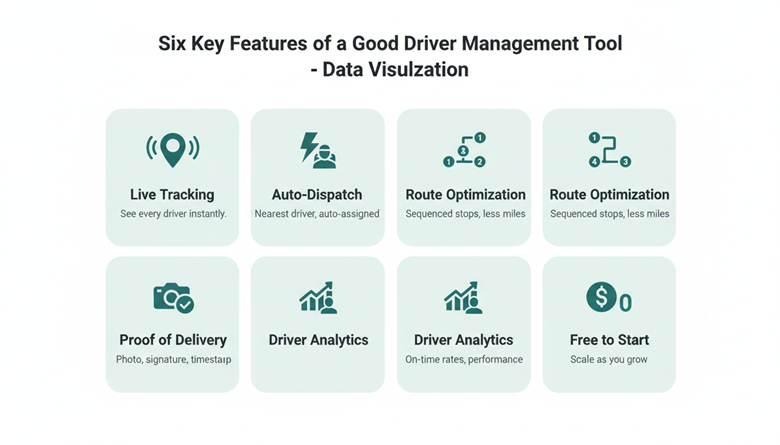
Real-Time Driver Tracking on a Live Map
You should see every driver’s position without asking. One glance tells you who is en route, who is stuck, and who just went idle. No calls. No texts. The map is the status update.
Auto-Dispatch Based on Proximity and Availability
Manual assignment breaks down past ten drivers. A good tool assigns the nearest available driver automatically. You stop playing Tetris with routes and start managing exceptions only.
Built-In Route Optimization and Navigation for Drivers
Drivers should not pick their own routes. A driver app with a route planner built in removes guesswork. It sequences stops, accounts for traffic, and launches turn-by-turn navigation. Fewer wrong turns. Fewer late deliveries.
See also: Revolutionizing Sleep with Modern Technology
Proof of Delivery — Photo, Signature, Timestamp
“I delivered it” means nothing without evidence. Photo capture, signature collection, and GPS-stamped timestamps protect you from disputes. They also give drivers clear accountability without you hovering.
Per-Driver Performance Analytics
You need to know who consistently delivers on time and who does not. Completion rates, average delivery times, and on-time percentages per driver turn gut feelings into decisions. This is how you coach instead of micromanage.
Free Tier to Start Without Risk
If a tool demands a big contract before you onboard your first driver, walk away. The best tools let you start at **zero cost** and scale pricing with your fleet. You should prove value before you spend.
Habits That Keep You Out of the Weeds
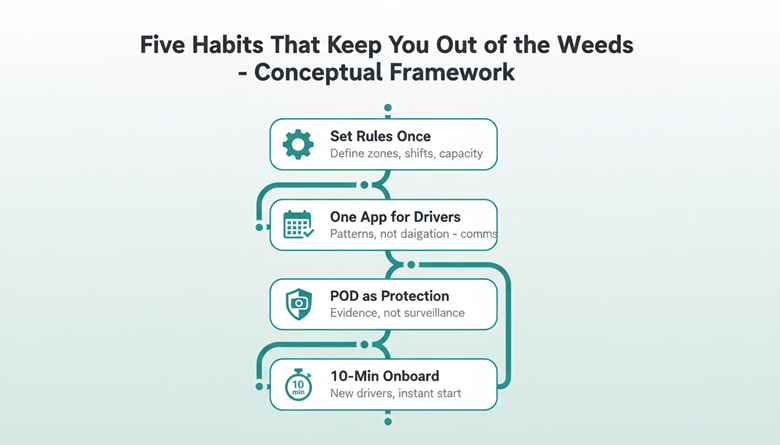
Set dispatch rules once, then trust them. Define zones, shift hours, and driver capacity upfront. Let the system assign orders. Intervene only when something breaks.
Review analytics weekly, not daily. Daily monitoring pulls you back into micromanagement. A weekly review of on-time rates and route efficiency gives you the pattern without the noise.
Give drivers a single app for everything. If your drivers juggle three apps — one for orders, one for navigation, one for communication — they will cut corners. A unified route planner with delivery details and navigation in one place reduces friction and errors.
Use proof of delivery to resolve disputes, not to surveil. Drivers who feel watched quit. Drivers who feel protected by evidence stay. Frame POD as their shield, not your microscope.
Onboard new drivers in under ten minutes. High turnover is a reality. If your system requires a training session to use, you will lose days every month just onboarding replacements.
Your Competitors Are Already Doing This
Delivery operations that adopted live tracking and auto-dispatch report cutting route planning time by 30-40%. That is hours back every week — hours spent acquiring customers instead of chasing drivers.
Fuel costs rose 20% over the past two years. Optimized routes are no longer a nice-to-have. Every unnecessary mile is money burned.
The teams still running group-chat dispatch are losing drivers to competitors who offer a smoother experience. Drivers talk. They know which operations run clean and which ones feel chaotic.
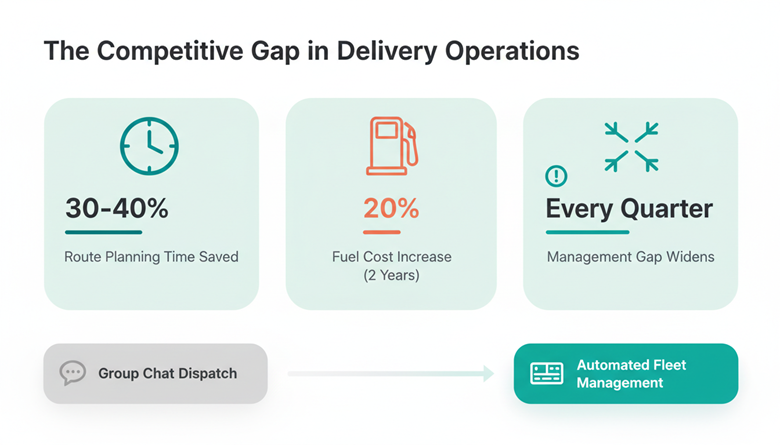
The gap between managed and unmanaged fleets widens every quarter. The tools exist. The cost to start is zero. The only question is how long you keep being the bottleneck.