
Modern lighting projects demand not only visual appeal and efficiency but also documented assurance of safety, quality, and environmental responsibility. As LED strip lighting continues to dominate residential, commercial, and industrial installations worldwide, certification and compliance have become essential pillars in both product development and project execution.
For engineers, architects, and project managers, understanding how certification affects product performance, safety, and approval processes is as critical as the lighting design itself. In this article, we break down what certification means, explore key global standards, and examine how engineering‑driven manufacturers such as SignliteLED more information leaders are implementing robust compliance frameworks to set benchmarks for reliability and market access.
Why Certification Matters in LED Projects
Certification is not a bureaucratic hurdle—it is the foundation of trust. In LED strip lighting, where electrical precision, heat management, and optical quality intersect, certification ensures the product meets quantified safety and performance parameters.
Its importance can be seen on three levels:
- Safety Assurance: Prevents electrical hazards, overheating, or short circuits in installations.
- Performance Validation: Confirms lumen output, color rendering, and lifetime projections under defined test conditions.
- Market Access and Legal Compliance: Allows products to be sold, installed, and warrantied in specific regions by meeting statutory regulations.
Without proper certification, even the best lighting designs can face project rejections, insurance limitations, or warranty disputes. Certification transforms “good lighting” into approved lighting—an important distinction in professional markets.
The Regulatory Landscape: Key Global Standards
LED strip lighting projects often cross regional borders. Each target market enforces distinct standards, but most share a common structure rooted in safety, electromagnetic compatibility (EMC), environmental compliance, and energy efficiency.
Let’s explore the most prominent certifications encountered in LED strip lighting.
1. UL and ETL (North America)
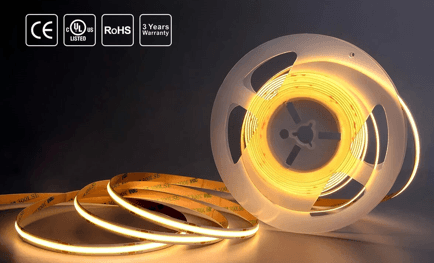
- UL (Underwriters Laboratories) marks confirm adherence to North American electrical safety standards (UL8750 for LED systems).
- ETL (Intertek) is functionally equivalent, verifying conformity to the same test benchmarks.
Both marks demonstrate that luminaires, drivers, and power accessories pose minimal risk of fire or electric shock.
2. CE Certification (Europe)
The CE mark guarantees conformity with the European Union’s General Product Safety, EMC, and Low Voltage Directives. It grants products free movement within the EU market.
For LED lighting, CE compliance means the strip and driver pass emission, immunity, and safety evaluations under EN standards (such as EN 55015 or EN 60598).
3. RoHS Directive
“Restriction of Hazardous Substances” (RoHS) prohibits harmful materials like lead, mercury, or cadmium in electrical products. Beyond regulation, RoHS supports sustainable production and end‑of‑life recycling programs.
4. FCC and EMC Compliance
The U.S. Federal Communications Commission (FCC) certification ensures lighting products do not cause or suffer from electromagnetic interference. Similarly, EMC directives in Europe certify signal stability within electrical networks—critical in intelligent lighting where data and power coexist.
5. TÜV and GS (Germany)
These certifications are prestigious voluntary marks showing a product’s quality exceeds basic CE conformity. TÜV or GS approval signals advanced manufacturing oversight and higher safety consistency.
6. CB Scheme (International)
Operated by the IECEE, the CB Scheme streamlines international certification by recognizing test reports among 50+ participating countries—enabling LED manufacturers to access multiple markets quickly.
7. LM and TM Standards (Performance Benchmarks)
While not certifications, technical metrics such as LM‑80 (lumen maintenance) and TM‑21 (lifetime projection) quantify performance data. These standards serve as scientific evidence supporting warranty claims and long‑term reliability expectations.
Certification Through the Product Lifecycle
Certification is not a one‑time event but a continuous process embedded throughout a product’s lifecycle: from design through production and post‑market monitoring.
Stage 1: Material and Component Compliance
The journey begins with selecting compliant raw materials—LED chips, adhesives, PCBs, and aluminum profiles must all be tested for RoHS and REACH adherence. Advanced manufacturers maintain supplier audits and incoming QC to verify batch traceability.
Stage 2: Prototype and Pre‑Compliance Testing
In this stage, design engineers collaborate with independent labs or in‑house testing facilities to simulate environmental, electrical, and mechanical stresses. Findings inform design improvements before third‑party testing begins.
Stage 3: Third‑Party Certification
Accredited laboratories such as UL, TÜV, or SGS conduct complete evaluations. Certificates and reports are issued only after the product meets every required criterion under controlled conditions.
Stage 4: Factory Inspection and Ongoing Surveillance
Many approvals, including UL and ETL, mandate follow‑up audits to verify continued compliance. Factories must maintain identical processes and materials to those verified during initial testing.
Stage 5: Documentation and Market Representation
Manufacturers must store test reports, declarations of conformity, and instructional documents as part of traceability. This documentation also supports customs approvals, project submittals, and warranty references.
How Compliance Drives Project Success
In professional lighting installations, proper certification carries direct operational and financial implications:
- Simpler Project Approval: Certified products are faster to approve in architectural and municipal projects.
- Reduced Liability: Contractors and designers limit risk exposure by specifying verified components.
- Long‑Term Maintenance Reliability: Certified components assure end‑users of stable performance and safety over time.
- Brand Reputation: Compliance reinforces confidence in suppliers and enhances global competitiveness.
Ultimately, compliance signals professionalism—providing reassurance to clients, insurers, and regulators alike that the system meets global expectations.
Engineering Verification: Beyond Paper Certificates
A responsible LED manufacturer does not stop at receiving certificates—it validates that internal engineering, production accuracy, and quality testing continuously align with certification criteria.
At engineering‑driven companies such as SignliteLED, compliance frameworks are integrated into every process:
- In‑House Photometric Labs: Verify lumen output, CCT, and CRI under calibrated environments.
- Thermal and Electrical Stress Tests: Simulate real working conditions to confirm stability.
- Aging and Endurance Testing: Long‑term performance validated by continuous operation cycles.
- Batch Traceability: ERP systems document material origin and production parameters for every batch.
This internal verification ensures the certification emblem on the product reflects ongoing reliability, not just a past laboratory result.
Compliance in Global Project Scenarios
Because LED strip systems are used across industries, compliance contexts differ depending on project scale and geography.
1. Commercial Interiors
Retailers and corporate offices prioritize CE, UL, and RoHS for safety and sustainability. Designers often rely on photometric test data (IES files) for model simulations and lighting software integration.
2. Outdoor and Architectural Lighting
For façades or landscape installations, IP and IK ratings—defining waterproof and impact resistance—join certification requirements. Municipal projects may further demand ISO environmental compliance and corrosion testing.
3. Signage and Advertising Applications
Channel letter and backlit systems require consistent brightness and EMC stability. Global brands demand suppliers with certified production under UL879 (Electric Sign Components).
4. Industrial and Transport Infrastructure
Airports and tunnels rely on durable, vibration‑resistant LED systems with UL, CE, and IECEx (hazardous‑area safety) approvals. These installations demand not just efficiency but absolute safety assurance.
By tailoring compliance documentation to fit these contexts, professionals can streamline approval, installation, and warranty management.
Environmental and Sustainability Certifications
Lighting no longer concerns electricity alone—climate responsibility now defines brand integrity. The shift toward sustainability brings additional layers of compliance:
- ISO 14001 Environmental Management: Certification of internal operational controls reducing waste and emissions.
- Energy Star & DLC Listings: Efficiency standards guiding U.S. energy rebates.
- WEEE Directive Compliance: Responsible recycling of electronic waste at end‑of‑life.
- Carbon Footprint Reporting: Lifecycle analyses supporting LEED and BREEAM certifications for building projects.
Manufacturers must document such efforts to align with global corporate social responsibility (CSR) frameworks and growing environmental legislation.
The Role of Engineering‑Driven Manufacturers
True compliance extends beyond meeting minimum directives—it reflects engineering discipline and company culture.
Brands such as SignliteLED practice a “quality‑by‑design” philosophy, embedding certification logic directly into R&D and production systems. The company’s foundation in Shenzhen’s high‑tech ecosystem provides access to:
- Automated SMT lines ensuring precise component placement and assembly.
- Digital QC systems linking each reel to test data for optical and electrical metrics.
- Professional staff training maintaining awareness of evolving UL, CE, and IEC standards.
As a result, products remain globally compliant while supporting engineers and designers who demand proof—not claims—of quality. For detailed insight into company heritage, testing infrastructure, and continuous improvement programs, explore SignliteLED more information.
See also: Top 5 Common Heating Problems Homeowners Face
Certification Documentation and Client Confidence
Delivering documentation properly is as vital as obtaining certification itself. Professional LED suppliers provide organized technical packages, usually including:
- Declaration of Conformity (DoC).
- Test reports (LM‑79, LM‑80, or TM‑21).
- Safety data sheets and installation manuals.
- Warranty policies linked to certified ratings.
These files support transparency between manufacturer, integrator, and end‑client—streamlining logistics and ensuring that on‑site inspectors can confirm specification compliance instantly. Today, digital systems allow automatic QR code tracking of certificates, giving project teams live database access to verify authenticity.
Legal and Ethical Aspects of Compliance
Certification also extends into the legal and ethical domains. Using non‑compliant products endangers not only users but entire project approvals. Authorities have the right to impose penalties, deny occupancy permits, or demand product replacement if lighting systems lack the appropriate certification.
Furthermore, falsified documentation poses reputational risks for both suppliers and contractors. Ethical manufacturers maintain traceability audits and cooperate with official testing organizations to ensure certificate integrity. In this sense, compliance functions as both a safety net and a moral contract with end‑users.
Common Pitfalls and How to Avoid Them
LED strip lighting projects occasionally encounter compliance oversights. Common issues include:
- Mixing certified and non‑certified components (e.g., using certified strips with uncertified power supplies).
- Improper driver pairing causing voltage instability and non‑compliance with EMC limits.
- Lack of documentation transfer between subcontractors and primary contractors.
- Failure to renew expired certifications after product iterations.
To avoid these pitfalls:
- Verify each product element carries matching certifications.
- Request updated DoCs with model numbers clearly identified.
- Partner only with manufacturers offering transparent test documentation.
- Include compliance review checkpoints in project timelines.
Continuous Improvement and Global Recognition
Compliance is a living discipline. As standards evolve, new test methods emerge—LM‑84 for system performance, IEC 62717 for LED modules, and IEC 62471 for photobiological safety. Continuous research keeps manufacturers ready for future revisions and developing markets.
Industry leaders undergo annual re‑certification and calibration audits to maintain this readiness. They also adapt swiftly to sustainability‑linked policies like the European Ecodesign directive and Asia‑Pacific energy labelling.
For lighting designers and contractors, choosing suppliers that maintain updated certificates and visibility across jurisdictions provides operational security and professional credibility. To review specific certifications and downloadable documentation, consult SignliteLED more information.
Conclusion
LED strip lighting projects stand at the intersection of design innovation and technical accountability. Certification and compliance are the mechanisms that bridge these worlds—translating engineering excellence into global acceptance, ensuring safety, and safeguarding the environment.
By working with verified, engineering‑driven partners who treat compliance not as formality but as philosophy, project stakeholders secure the reliability, longevity, and ethical foundation of every installation.
From proof of safety to promise of sustainability, compliance turns light into assurance—and assurance into confidence that shines as brightly as the illumination itself.