
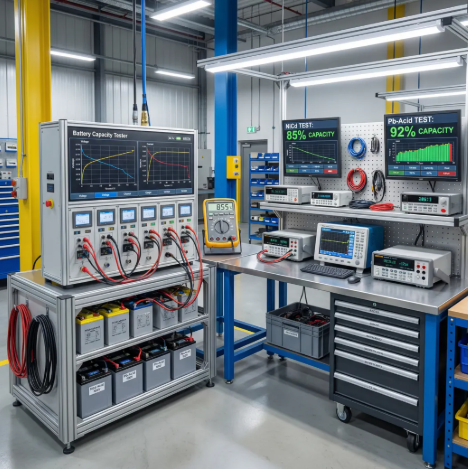
Aircraft Battery Capacity Tester vs Standard Load Tester: What’s the Difference?

In aviation maintenance, battery testing is not optional—it’s essential. Aircraft electrical systems depend on precise battery performance, and testing methods must meet strict safety and compliance standards.
Two common testing tools are the aircraft battery capacity tester and the standard load tester. While both evaluate battery condition, they serve very different purposes.
For MRO facilities, airline engineers, and aviation procurement teams, understanding the distinction is critical when choosing the right equipment.
What Is an Aircraft Battery Capacity Tester?
An aircraft battery capacity tester is a specialized device designed to:
- Perform controlled discharge testing
- Measure actual amp-hour (Ah) capacity
- Evaluate battery health under aviation-specific standards
- Generate detailed compliance documentation
It simulates real operational loads over time, measuring how long a battery can sustain a defined discharge rate.
This type of testing reflects the true usable capacity of the battery.
What Is a Standard Load Tester?
A standard load tester typically:
- Applies a short-duration high load
- Measures voltage drop response
- Assesses internal resistance
- Provides a quick pass/fail indication
Load testers are commonly used in automotive and general industrial applications. They are fast and convenient—but they do not measure full discharge capacity.
Core Differences Between the Two
1. Testing Depth
Aircraft Battery Capacity Tester:
Performs full discharge testing to measure actual capacity.
Standard Load Tester:
Applies a brief load to check voltage behavior.
Capacity testers provide a comprehensive performance assessment. Load testers provide a surface-level health check.
2. Accuracy in Aviation Applications
Aircraft systems demand predictable performance over specific time durations.
- Capacity testers simulate real discharge cycles.
- Load testers do not measure sustained performance.
In aviation, knowing whether a battery can deliver power for the required duration is far more important than a quick voltage check.
3. Regulatory Compliance
Aviation authorities require documented proof of battery capacity.
An aircraft battery capacity tester:
- Records discharge curves
- Logs amp-hour output
- Provides printable or digital compliance reports
Standard load testers generally do not provide documentation suitable for aviation audits.
4. Application Suitability
| Feature | Aircraft Battery Capacity Tester | Standard Load Tester |
| Measures True Capacity | Yes | No |
| Simulates Real Flight Conditions | Yes | No |
| Suitable for Aviation Compliance | Yes | Limited |
| Quick Diagnostic Check | Moderate | Yes |
| Detailed Reporting | Yes | Minimal |
For aviation environments, capacity testers are purpose-built. Load testers are typically not designed for aerospace-grade requirements.
See also: How Commercial Construction Services Support Businesses
5. Safety and Risk Mitigation
A battery that passes a load test may still fail a full discharge capacity test.
In aviation, this difference matters.
Capacity testing:
- Identifies declining batteries before failure
- Reduces in-flight electrical risk
- Prevents unexpected downtime
Load testing:
- May miss gradual capacity loss
- Offers limited predictive insight
6. Long-Term Maintenance Strategy
Airlines and MRO providers aim to:
- Reduce unscheduled maintenance
- Extend battery lifecycle predictability
- Maintain fleet readiness
An aircraft battery capacity tester supports proactive maintenance planning by tracking performance trends over time.
Load testers are better suited for quick preliminary screening rather than lifecycle management.
When Should You Use Each?
Use an Aircraft Battery Capacity Tester when:
- Performing scheduled maintenance checks
- Meeting aviation regulatory requirements
- Verifying rated battery capacity
- Supporting compliance documentation
- Managing fleet reliability
Use a Standard Load Tester when:
- Conducting rapid preliminary checks
- Testing non-aviation batteries
- Performing general industrial diagnostics
Why the Difference Matters in Aviation
In commercial and military aviation, electrical system reliability is non-negotiable.
An aircraft battery capacity tester evaluates whether a battery can deliver power for the exact duration required in emergency scenarios. That level of testing cannot be replaced by a short-duration load check.
For engineering teams assessing testing accuracy, compliance readiness, and long-term reliability, selecting the right equipment directly impacts operational safety.
Final Thoughts
While both tools assess battery condition, they are not interchangeable.
A standard load tester offers quick diagnostics. An aircraft battery capacity tester delivers comprehensive, aviation-grade performance validation.
For aviation maintenance teams focused on safety, compliance, and operational efficiency, capacity testing remains the gold standard.